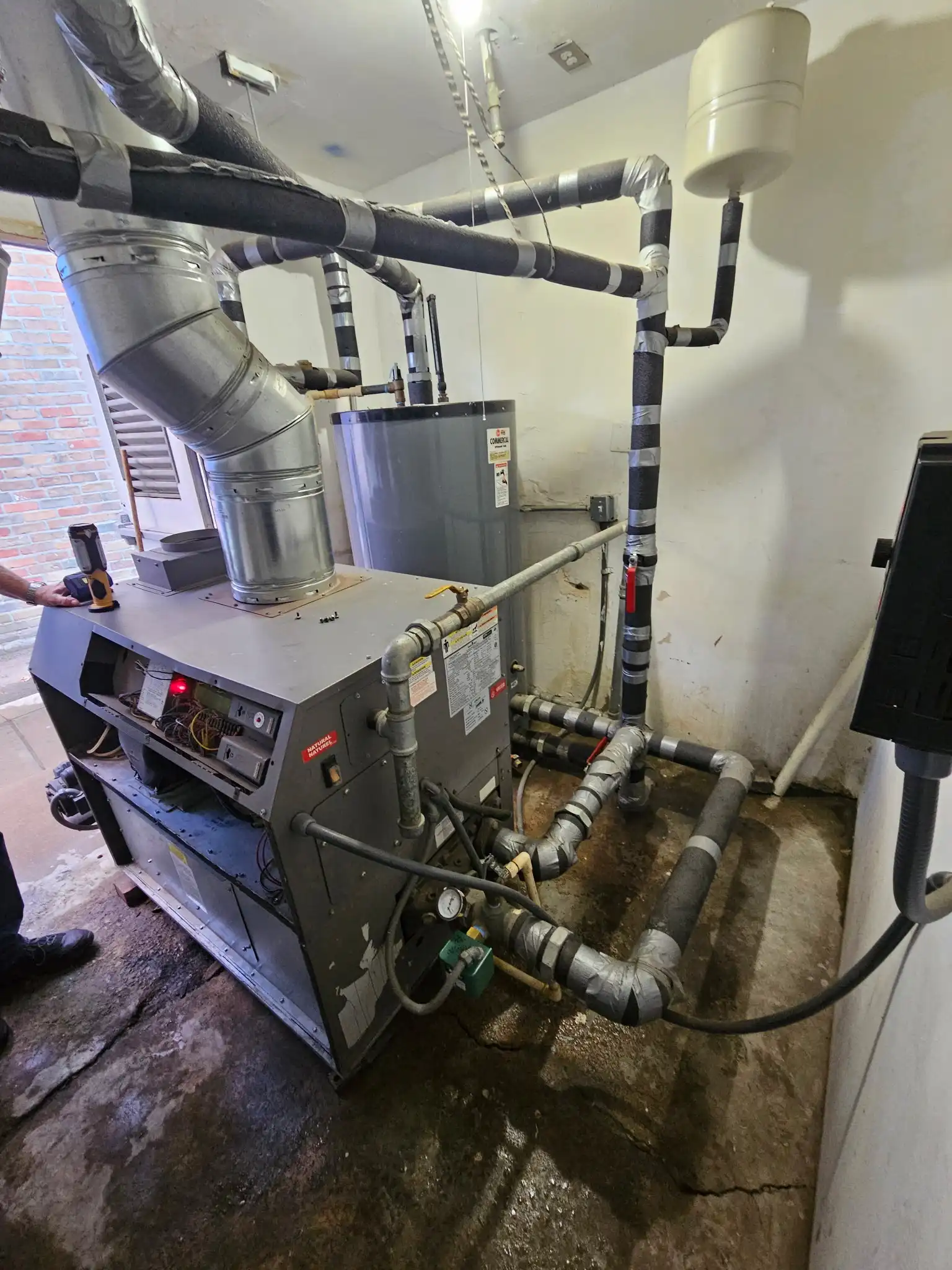
For commercial buildings in Texas, boiler capacity is sized using a heat loss calculation based on square footage, insulation, occupancy type, and hot water demand. Houston falls in ASHRAE Climate Zone 2, so most commercial buildings require 30 to 40 BTU per square foot for heating, far less than colder states. The right boiler capacity depends on your building’s peak heating load, domestic hot water usage, and whether redundancy is needed. A licensed plumbing or mechanical contractor performs a Manual J or equivalent load calculation to determine the correct size. Oversizing wastes energy through short-cycling; undersizing leaves your building cold during Texas freeze events.
When building managers and property owners in Houston start asking about boiler capacity, the conversation usually goes one of two ways. Either they are replacing an aging unit and want to know if they should go bigger, or they are dealing with energy bills that have gotten out of control and suspect the current system is part of the problem. Both situations point to the same root issue: the boiler was never sized correctly for the building in the first place. Getting this right from the start saves money, extends equipment life, and keeps your building running the way it is supposed to.
If you have already searched for boiler repair near Houston, TX and found yourself down a rabbit hole of technical specs, this guide is meant to cut through the noise with practical, Texas-specific guidance.
Why Texas Commercial Buildings Have Unique Sizing Needs
Houston sits in ASHRAE Climate Zone 2, which is a warm-humid subtropical classification. What that means practically is that your commercial building loses far less heat in winter than a similar structure in Chicago or Denver. In colder climates, buildings need 60 to 80 BTU per square foot or more for heating. In Houston and most of Texas, that number drops to roughly 30 to 40 BTU per square foot.
This is important because many contractors and building owners default to oversized boilers, thinking more capacity equals more reliability. In Texas, that logic backfires. An oversized boiler short-cycles constantly, turning on and off before reaching steady operating temperature. Short-cycling burns excess fuel, creates thermal stress on heat exchangers, and wears out components far faster than a properly sized unit would. You end up with higher utility bills and more frequent repair calls.
The other complicating factor unique to Texas commercial buildings is domestic hot water demand. In climates where heating loads dominate, the boiler is mainly warming air-side systems. In Houston, your building’s hot water demand for restrooms, kitchens, laundry, or process equipment often equals or exceeds the space heating load. A hotel or restaurant in the Houston area may need up to five gallons of hot water per guest per day at 120 degrees Fahrenheit or higher. That load has to be factored into the capacity calculation, not added as an afterthought.
The Core Factors That Determine Boiler Capacity
There is no shortcut to accurate commercial boiler sizing. Square footage alone will not get you there. A proper heat loss calculation considers all of the following:
- Total heated square footage and ceiling heights above the standard eight feet
- Wall, roof, and window insulation values (R-values and U-factors)
- Air infiltration rates based on building age and construction type
- Occupancy type and schedule, since a hospital runs continuously while an office building has off-hours
- Domestic hot water demand at peak usage periods
- Process loads if the building houses commercial kitchens, laundry, or manufacturing
- Outdoor design temperature for Houston, which ASHRAE sets at 32 degrees Fahrenheit for heating design day
The calculation methodology most commonly used is based on ASHRAE Handbook: Fundamentals and Manual J procedures. These account for heat transfer through every element of the building envelope and give you the actual BTU per hour your boiler needs to deliver at peak demand. Anything less than this kind of detailed analysis is guesswork, and in commercial settings, guesswork means either wasted energy or an uncomfortable building.
Boiler Types and What Each One Is Suited For
Commercial boilers in Texas generally fall into three main categories, and the right choice depends on your building’s size, application, and pressure requirements.
- Fire-tube boilers are the most common choice for small to mid-sized commercial buildings like offices, schools, and retail centers. Hot combustion gases travel through tubes surrounded by water. They handle capacities up to roughly 2,500 boiler horsepower and are known for lower upfront cost and simpler maintenance routines. If your building has a straightforward heating and hot water load under that threshold, a fire-tube unit is often the practical choice.
- Water-tube boilers reverse the arrangement, placing water inside the tubes with hot gases surrounding them. They support higher pressures and much larger outputs, making them the standard for large hospitals, industrial facilities, and multi-building campuses. They ramp up faster and handle variable loads more efficiently, but they require more floor space and specialized operation.
- Condensing boilers recover heat from flue gases that traditional boilers simply exhaust. They achieve 90 to 99 percent combustion efficiency, but only when return water temperatures stay below 130 degrees Fahrenheit. In Texas, where the heating season is mild and systems spend significant time at partial load, return water temperatures often meet that threshold, making condensing boilers a strong option for buildings focused on long-term energy savings.
Proper boiler maintenance in Texas extends regardless of type, and the right unit for your building is the one that matches your actual load, not the one with the most impressive spec sheet.
Modular Systems and Redundancy Planning
One approach that is gaining significant traction in Texas commercial buildings is the modular boiler configuration, where two or more smaller boilers work together as a single system rather than relying on one large unit.
The advantages are real. Multiple smaller boilers can be staged to match partial loads throughout the year, running one unit at high efficiency on a mild January day and bringing in additional units during the occasional hard freeze. This kind of turndown flexibility is critical in Texas, where heating demand swings widely from season to season and even week to week.
For critical facilities like hospitals, data centers, and large multi-tenant buildings, an N+1 redundancy configuration is the standard. That means two boilers share the load under normal conditions, with a third unit on standby. If one goes offline for service or an unexpected failure, the building never loses heating. Texas saw firsthand during February 2021 how vulnerable commercial infrastructure can be during extreme cold events. Redundancy planning is no longer optional for facilities that cannot afford downtime.
If you are evaluating your current system or planning a new installation, reach out to G.O. Plumbing at +1 713-827-7771. Their team serves commercial clients across Houston and can assess your building’s actual load and help you determine whether a single high-capacity unit, a modular setup, or a full system upgrade is the right call for your situation.
Texas Regulatory Requirements You Cannot Ignore
Commercial boiler installation in Texas involves more than picking the right BTU rating. There are specific regulatory checkpoints that apply to every commercial installation in the state.
- The Texas Department of Licensing and Regulation (TDLR) requires that all commercial boilers, unless specifically exempted under Texas Health and Safety Code Section 755.022, be inspected and certified before operation. Skipping this step is not just a code violation; it creates significant liability exposure for building owners.
- The Texas Commission on Environmental Quality (TCEQ) regulates NOx emissions from commercial boilers statewide under Title 30, Texas Administrative Code, Chapter 117. These rules affect burner system selection and apply to all new installations.
- Boilers with a heat input greater than 40 MMBtu using natural gas as the primary fuel must obtain authorization under the TCEQ Air Quality Standard Permit for Boilers. This permitting step needs to be built into your project timeline before installation begins.
- The Texas Boiler Code specifically requires carbon monoxide monitors and controls as part of boiler room design. This is a state-level requirement that goes beyond what the International Building Code mandates.
- Boiler rooms themselves must comply with IBC Section 509.1, requiring at minimum a one-hour fire-rated wall separation or an automatic sprinkler system protecting the space.
Working with a licensed contractor who knows these requirements is not just a convenience; it is the only way to ensure your installation does not result in costly post-installation corrections or permit issues. For a boiler install in Texas, compliance with TDLR and TCEQ requirements from day one is non-negotiable.
Turndown Ratio: The Metric Most Building Owners Overlook
One spec that rarely gets discussed in plain terms is the turndown ratio. It describes how much a boiler can reduce its firing rate while still operating stably. A boiler with a 10:1 turndown ratio can drop to 10 percent of its maximum output without shutting off.
In Texas, where your commercial building might need full heating capacity on a rare freeze day but only 20 to 30 percent capacity on a typical December afternoon, a high turndown ratio is genuinely valuable. It means the boiler modulates smoothly to match actual demand instead of cycling on and off repeatedly. You get steadier comfort, less fuel waste, and less mechanical wear.
When comparing boiler options for your building, ask for the turndown ratio alongside the BTU rating. A unit with a 5:1 ratio and adequate BTU capacity will often outperform a larger unit with a 3:1 ratio in real-world Texas operating conditions.
For more detailed guidance on ASHRAE load calculation standards used by engineers during commercial boiler sizing, the ASHRAE Handbook: Fundamentals is the reference document most contractors and engineers rely on.
Common Sizing Mistakes Texas Building Owners Make
After years of working on commercial systems in the Houston area, a few patterns keep coming up in buildings where the boiler was not sized correctly.
- Using residential calculators or rules of thumb meant for single-family homes. Commercial buildings have fundamentally different occupancy patterns, ventilation requirements, and hot water demand profiles.
- Sizing the boiler based on the old unit’s capacity rather than the building’s actual current load. Buildings get insulation upgrades, occupancy changes, and window replacements over time. The old unit’s BTU rating reflects the load from years or decades ago.
- Ignoring pipe distribution losses. Heat is lost as hot water travels from the boiler through the building’s piping network. In larger buildings, these distribution losses can meaningfully affect what the boiler actually needs to produce.
- Forgetting about future expansion. If your building is likely to add square footage, new tenants with higher hot water demands, or process equipment, sizing without a buffer for that growth forces a full system replacement sooner than expected.
- Choosing a boiler with a low turndown ratio because it was priced lower. In Texas’s mild climate, partial-load operation is the norm, and a poor turndown ratio negates the savings from a lower purchase price within a few years of operation.
Getting It Right the First Time
Commercial boiler sizing is not a task where getting close is good enough. The difference between a properly sized system and one that is 30 percent oversized can represent thousands of dollars annually in wasted fuel, plus accelerated maintenance costs and a shorter equipment lifespan.
The process starts with a thorough heat loss and hot water demand assessment of your specific building, using actual measurements and current building data, not assumptions. From there, the right boiler type, capacity, configuration, and controls can be matched to your actual needs.
G.O. Plumbing works with commercial clients throughout Houston and the surrounding area to handle exactly this kind of project, from the initial load assessment through installation, permitting, and long-term maintenance. Give them a call at +1 713-827-7771 or visit thegoplumbing.com to talk through what your building actually needs.
Frequently Asked Questions
1. What size boiler do I need for a commercial building in Texas? The answer depends on your building’s heat loss calculation, not square footage alone. In Houston’s climate, most commercial buildings fall in the range of 30 to 40 BTU per square foot for heating load, but domestic hot water demand, occupancy type, and building envelope quality all affect the final number. A licensed contractor should perform a proper load calculation before any boiler is selected.
2. How do I know if my commercial boiler is oversized? The clearest sign is frequent short-cycling, where the boiler fires for a short period, reaches setpoint quickly, shuts off, and then fires again shortly after. Other signs include higher than expected fuel bills, uneven heating throughout the building, and premature wear on burner components. A technician can confirm oversizing by measuring run times and comparing them to the building’s actual demand.
3. What are the Texas regulations for commercial boiler installation? Commercial boilers in Texas must be inspected and certified by the Texas Department of Licensing and Regulation (TDLR) before operation. The TCEQ regulates NOx emissions statewide and requires a standard air quality permit for boilers with heat inputs above 40 MMBtu. Boiler rooms must also comply with IBC fire-rating requirements, and Texas specifically requires carbon monoxide monitors in boiler rooms.
4. How often should a commercial boiler be serviced in Texas? Most commercial boilers should receive a full inspection and tune-up at least once per year, typically before the heating season. Systems that also provide year-round domestic hot water may require more frequent attention. Annual maintenance typically includes burner adjustment, heat exchanger inspection, flue gas analysis, safety control testing, and water treatment checks.
5. What is the difference between a fire-tube and a water-tube boiler for commercial use? In a fire-tube boiler, hot combustion gases pass through tubes surrounded by water, which is the simpler and more common design for small to mid-sized commercial buildings. In a water-tube boiler, water flows inside the tubes and hot gases surround them, supporting higher pressures and larger capacities. Water-tube boilers are typically used in hospitals, large industrial facilities, and high-pressure steam applications.
6. Can I use a residential boiler for a small commercial building in Texas? Generally no. Commercial boilers are engineered for continuous or heavy-use operation, more complex controls, higher hot water volumes, and stricter regulatory requirements. A residential boiler used in a commercial setting would be undersized for the demand, may not meet code requirements, and would likely fail prematurely under the usage load.
7. How long does a commercial boiler last in Texas? With proper maintenance, most commercial boilers last between 20 and 30 years. Fire-tube units tend to have longer service lives in lower-pressure applications, while water-tube systems and condensing boilers require more attention to maintain peak performance. Houston’s humidity and hard water conditions can accelerate corrosion and scale buildup, making water treatment and routine maintenance especially important in this region.
8. What is a good turndown ratio for a commercial boiler in Texas? For Texas commercial buildings, a turndown ratio of 10:1 or higher is ideal. Because the heating season is mild and buildings spend most of their operating time at partial load, a high turndown ratio allows the boiler to modulate smoothly rather than short-cycling. This reduces fuel consumption, lowers wear on components, and maintains more consistent building temperatures throughout the season.
9. Is a condensing boiler worth it for a commercial building in Houston? In many cases, yes. Condensing boilers achieve 90 to 99 percent efficiency but require return water temperatures below 130 degrees Fahrenheit to operate in condensing mode. In Houston’s mild winters, systems frequently operate at partial load with lower return temperatures, which means condensing boilers can achieve their efficiency advantage more often than in colder climates. The payback period depends on the building’s hot water profile and current fuel costs.
10. How much does it cost to install a commercial boiler in Texas? Commercial boiler installation costs vary widely based on boiler size, type, configuration, and site-specific factors like piping runs, mechanical room modifications, and permitting requirements. Smaller commercial systems in the 300 to 500 MBH range typically start in the tens of thousands of dollars for equipment and installation combined, while larger systems for hospitals or industrial facilities can reach six figures. Getting a site-specific assessment from a licensed contractor is the only reliable way to understand true project costs.