In Texas, backflow prevention assemblies must be tested at least once a year. This applies to both residential and commercial properties connected to a public water supply where a cross-connection risk exists. The City of Houston enforces annual backflow testing through its Cross Connection Control Program, and testing must be performed by a TCEQ-licensed tester who is also registered with the City. A qualified and licensed certified backflow tester is responsible for inspecting the device, verifying that it functions properly, and submitting the required test documentation. Skipping annual backflow testing can result in fines of up to $2,500 per day and potential water service suspension.
If you have a backflow preventer on your property in Houston or anywhere else in Texas, there is a straightforward answer to this question. You need to have it tested at least once a year. That is the baseline set by the state, and cities like Houston layer their own requirements on top. Miss that window, and you are looking at fines, compliance notices, or worse. But understanding exactly what is required, who can legally perform the test, and what happens when a device fails is where most homeowners and business owners get confused. Let’s break it down.
What Is Backflow and Why Does Testing Matter?
Backflow occurs when water flows in reverse through your plumbing system. Instead of clean water flowing in from the municipal supply, pressure changes or siphoning events can pull water back from your property into the public water lines. That reversed water can carry fertilizers, chemicals, bacteria, or even sewage along with it. The contamination risk is real. The reason Texas treats this seriously enough to regulate it at the state level is that a single failed backflow device can affect far more than one property.
The Texas Commission on Environmental Quality, known as TCEQ, governs backflow prevention statewide under Title 30, Chapter 290 of the Texas Administrative Code. Every city in Texas that operates a public water system must comply with these rules, and many cities add their own enforcement on top. Houston is one of the most active cities in the state when it comes to tracking and enforcing compliance.
How Often Is Backflow Testing Required in Texas?
The state rule is clear. TCEQ requires that all backflow prevention assemblies be tested upon installation, after any repair or relocation, and at a minimum once annually after that. The question of how often is backflow testing required does not leave much room for interpretation. Once a year is the floor, not a suggestion.
For Houston property owners specifically, the City of Houston’s Cross Connection Control Program mirrors the TCEQ standard and adds its own layer of local enforcement. All registered backflow prevention assemblies in Houston must be tested at installation, after any repair or relocation, and every year going forward. The City tracks compliance through a third-party software platform called SwiftComply, where your licensed tester is required to upload results after each test. If your tester submits the results and the device passes, you are in compliance. If no results are submitted, the system considers you out of compliance regardless of whether a test was actually done.
It is also worth noting that annual backflow testing is not purely a commercial requirement. Homeowners with irrigation systems are specifically required to have their Pressure Vacuum Breaker tested every year. This catches a lot of Houston homeowners off guard when they receive a notice from Houston Public Works, but the requirement has been in place for years and applies city-wide.
Who Can Perform Backflow Testing in Houston?
This is where some property owners run into trouble. Not every plumber or irrigation technician is authorized to perform a legally valid backflow test in Houston. To do it properly, the tester must hold a current TCEQ Backflow Prevention Assembly Tester license, also called a BPAT license, and must be separately registered with the City of Houston. Both credentials are required. A TCEQ license alone does not qualify someone to submit results to the City.
A proper backflow inspection in Houston also requires the tester to use calibrated gauges with current calibration certificates, which are themselves renewed on an annual basis. This is not bureaucratic formality. Accurate pressure readings are the core of what the test is measuring, and a gauge that has drifted out of calibration can produce a passing result on a device that is actually failing.
If you need backflow testing near Houston and are unsure whether a company is qualified, you can verify TCEQ BPAT licenses through the TCEQ’s public license lookup tool at tceq.texas.gov. Ask any tester you hire for their TCEQ license number and confirm they are on the City of Houston’s approved tester list before scheduling anything.
What Types of Backflow Devices Are Used in Texas?
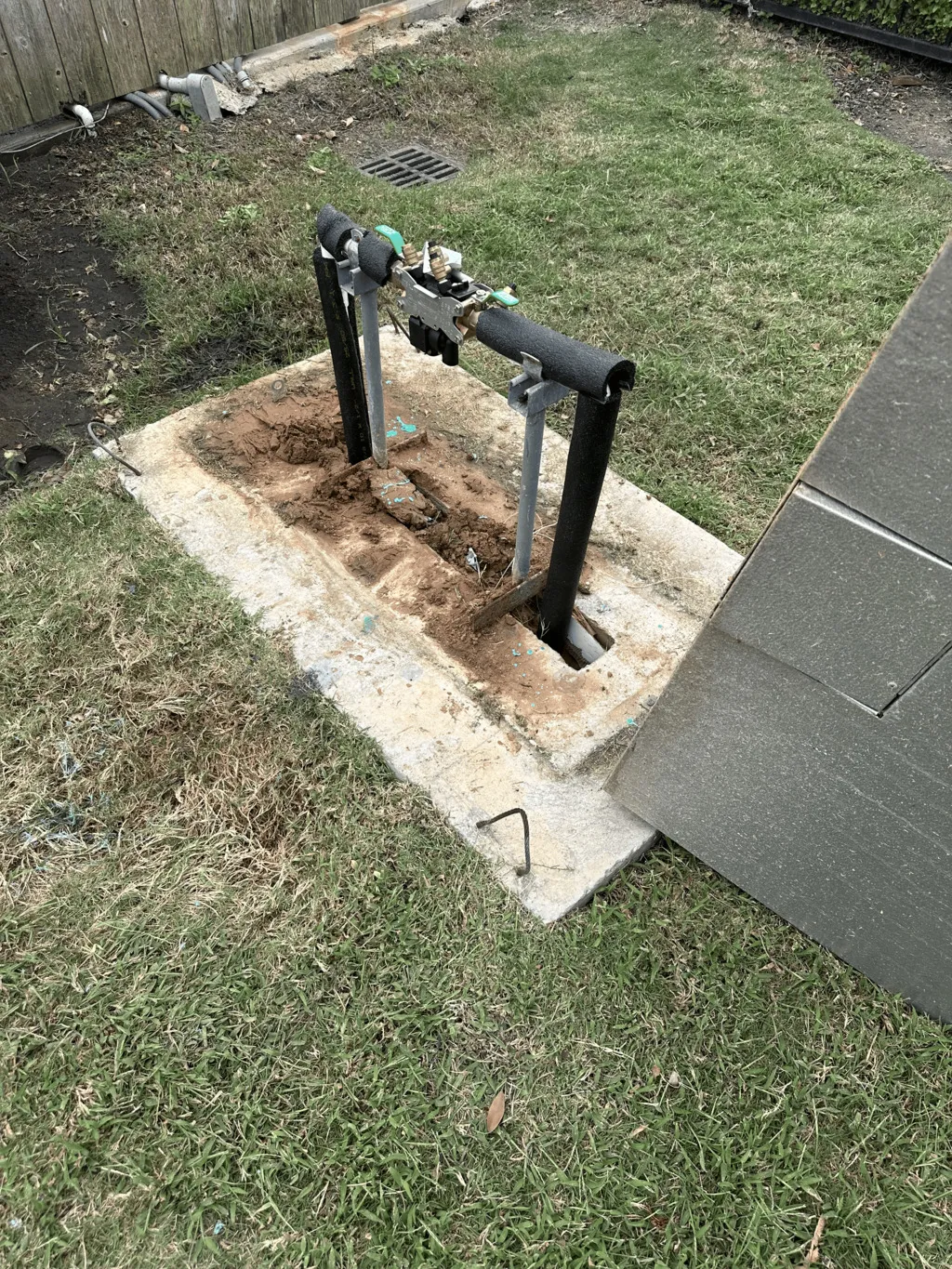
Texas recognizes three main types of testable backflow prevention assemblies. The first is the double check valve assembly, which is typically used in lower-hazard situations like general commercial connections. The second is the reduced pressure zone assembly, commonly called an RPZ, which is required for high-hazard applications where contamination could pose a serious health threat. The third is the pressure vacuum breaker, the type most commonly found on residential and light commercial irrigation systems in Houston.
Each device type has its own testing procedure, and the appropriate device for a given property depends on what kinds of cross-connection hazards exist. Restaurants, car washes, hospitals, dental offices, and properties with fire suppression systems are all considered higher-hazard locations and are typically required to have RPZ assemblies. The wrong device installed at a high-hazard location will not pass inspection regardless of its condition, so if you have never confirmed your device type with a licensed professional, it is worth having that conversation.
If your property falls into any of those higher-risk categories and you have questions about compliance, the team at G.O. Plumbing can walk you through what your specific setup requires. Call us at +1 713-827-7771 and we will help you figure out where you stand before your next test is due.
What Happens If You Skip Annual Backflow Testing?
The consequences in Houston are not theoretical. The City of Houston’s Cross Connection Control Program can issue citations with fines of up to $2,000 per day for non-compliance. Houston Public Works also has the authority to suspend water service to a property that remains out of compliance after repeated notices. For commercial properties, that can mean operational shutdowns. For homeowners, it means no water until a passing test report is on file.
There is also a liability dimension that does not get discussed enough. If your untested backflow device fails and contamination reaches neighboring properties or the wider water supply, you can be held personally responsible for remediation costs and legal claims. Insurance policies may not cover damages that result from regulatory non-compliance, which leaves property owners exposed in ways that a simple annual test would have prevented entirely.
If you fail the test itself, the clock starts running. In Houston, a failed test means your location remains out of compliance until a passing test report is submitted. You will need to have the device repaired and retested, and you should treat that timeline seriously. Repairs and retests need to be completed and uploaded to SwiftComply before compliance is restored.
What Causes a Backflow Device to Fail?
Backflow preventers are mechanical devices and they wear out over time. The most common failure causes include debris trapped inside the check valves or relief valve, worn-out springs or rubber seals, mineral buildup from Houston’s hard water, freeze damage from winter events, and general age-related wear. Houston’s climate adds a specific dimension here. The city’s water infrastructure sees significant pressure fluctuations, and freeze events like Winter Storm Uri demonstrated exactly how vulnerable local plumbing systems can be. All of that stress takes a toll on backflow assemblies over time.
Annual backflow testing exists precisely because these devices do not announce when they have stopped working. A device that looked fine last year can fail quietly after a single hard freeze, a main break, or a surge in water usage nearby. The only way to know it is still functioning is to test it.
When Else Should You Test Outside the Annual Cycle?
The annual cycle is the minimum. There are specific situations where a backflow assembly should be tested outside of that schedule. Any time a device is repaired or replaced, it needs to be tested before it returns to service. If your property undergoes significant plumbing work, a repipe, or a service line repair, a retest is appropriate. After any major pressure event near your property, such as a nearby water main break or heavy construction activity affecting local water pressure, it is smart to have the device checked rather than wait until your next scheduled test date.
Staying Compliant Is Simpler Than It Sounds
For most Houston homeowners and businesses, staying on top of annual backflow testing comes down to scheduling it once a year with a qualified tester and making sure the results get submitted to the City. The test itself typically takes less than an hour for a single device. The documentation is handled by your tester through SwiftComply. Your job is mostly to make sure you are using some
………one who is both TCEQ-licensed and Houston-registered, and that you are not letting the annual deadline slip.
G.O. Plumbing handles backflow testing for Houston residential and commercial customers with fully licensed technicians who are registered with the City of Houston and will submit your results directly. If your test is coming up or overdue, reach out to us at +1 713-827-7771 to schedule your annual backflow testing and stay on the right side of the City’s compliance requirements.
Frequently Asked Questions
1. How often is backflow testing required in Texas? Texas requires backflow prevention assemblies to be tested at a minimum once a year. Testing is also required at initial installation and after any repair or relocation of the device. Some high-hazard commercial properties may face more frequent inspection requirements depending on local utility rules.
2. Is annual backflow testing required for homeowners in Houston? Yes. Houston homeowners with irrigation systems are required to have their backflow prevention device, typically a Pressure Vacuum Breaker, tested every year. This is enforced by the City of Houston’s Cross Connection Control Program and is not optional.
3. What happens if I don’t get my backflow tested in Houston? The City of Houston can issue citations with fines of up to $2,000 per day for non-compliance. In serious or repeated cases, Houston Public Works has the authority to suspend your water service until a passing test report is submitted to the City.
4. Who is allowed to test backflow in Houston? In Houston, backflow testing must be performed by someone who holds a current TCEQ Backflow Prevention Assembly Tester (BPAT) license and is separately registered with the City of Houston. Both credentials are required for the test results to be accepted by the City.
5. What does a backflow test actually check? A backflow test checks whether the mechanical components of your backflow prevention assembly, including check valves, relief valves, springs, and seals, are functioning correctly and maintaining the required pressure differentials to prevent reversed water flow. The tester uses calibrated pressure gauges to measure performance against the device’s specifications.
6. How long does a backflow test take? For a standard single-device test on a residential or light commercial property, a backflow test typically takes between 30 minutes and one hour. More complex properties with multiple assemblies will take longer depending on the number of devices and their locations.
7. What happens if my backflow device fails the test? A failed test means your property is out of compliance until a passing result is submitted. You will need to have the device repaired by a qualified plumber and then retested. In Houston, failed results are logged in SwiftComply and compliance is not restored until a passing report is uploaded by your tester.
8. Can I test my own backflow preventer in Texas? No. Texas law requires backflow prevention assemblies to be tested by a TCEQ-licensed Backflow Prevention Assembly Tester. Self-testing is not legally valid for compliance purposes, and in Houston the tester must also be registered with the City.
9. Does a new backflow preventer still need to be tested annually? Yes. All testable backflow prevention assemblies in Texas are required to be tested annually regardless of age. A brand-new device must be tested at installation and then every year after that.
10. Why does Houston require annual backflow testing specifically? Houston’s aging water infrastructure, high water demand, and periodic freeze events all create pressure fluctuations that can stress backflow devices over time. Annual backflow testing ensures that devices which may have degraded due to these local conditions are identified and repaired before a contamination event can occur. The City enforces this through its Cross Connection Control Program in alignment with TCEQ statewide standards.